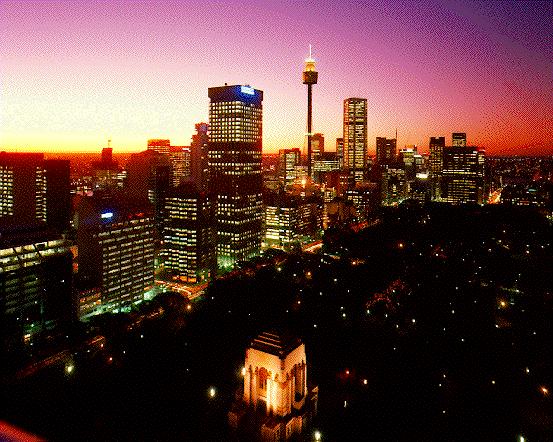
 Sydney by Night (full size 63k)
Sydney by Night (full size 63k)
1768 James Cook promoted to Lieutenant and given command of the "Endeavour" on an expedition with Sir Joseph Banks and other scientists to observe the transit of Venus from Tahiti, to investigate the possible existence of a southern continent and to annex any new lands he discovered. During this voyage he circumnavigated New Zealand and surveyed the east coast of Australia, landing in Botany Bay in 1770 and taking possession of it in the name of Great Britain.
1785
The British Government has a growing problem with regard to the accommodation of convicts and considers relocation to distant outposts as a promising solution. The destinations considered include the Honduras, the River Gambia, the Cape of Good Hope, and New South Wales. And the winner is ...
1786
The establishment of a colony in New South Wales was authorised by the Home Secretary, Lord Sydney. He ordered "that you do forthwith take such measures as may be necessary for providing a proper number of vessels for the conveyance of seven hundred and fifty convicts to Botany Bay, together with such provisions, necessaries and implements for agriculture as may be necessary for their use after their arrival." Captain Arthur Phillip, R.N., was commissioned to govern the colony.
1787
(13 May) The first fleet, which consists of two naval vessels, six transports and three store ships, finally sails. (It travels via Teneriffe, Rio de Janeiro and the Cape of Good Hope)
1788
(18 January). The fastest boat, the "Supply", arrives at Botany Bay around afternoon tea time. The Governor and other officers almost immediately launched rowboats and went exploring. They had their first encounter with the local aboriginal residents, who later directed them to a source of fresh water.
(20 January) The whole fleet was at anchor at Botany Bay by 10am. John White, the Surgeon-General, wrote "To see all the ships safe in their destined port without ever having, by any accident, been one hour separated; and all the people in as good health as could be expected or hoped for after so long a voyage, was a sight truly pleasing, and at which every heart must rejoice. Thus it is was that my only sadness on this day was brought on by the discovery of a video which I neglected to return prior to our embarkation."
The next morning Governor Phillip and other officers again went exploring the surrounding countryside, and Lieutenant Philip Gidley King described one of their meetings with the local aborigines, "They wanted to know what sex we were, which they explained by pointing where it was distinguishable. As they took us for women, not having our beard grown, I ordered one of the people to undeceive them in this particular, when they made a great shout of admiration..."
(24 January) The French arrive in Botany Bay, headed by Comte de la Perouse - beaten by just six days - and hence you're reading this in English
(26 January) Over the last few days Governor Phillip has been exploring Port Jackson (Sydney Harbour). He decides it has better karma and so everyone cruises around there, with the formal landing occurring today. Attempts at farming begin almost immediately at Farm Cove (now the Botanic Gardens site)
(7 February) The colony of New South Wales was formally proclaimed
(10 May) The French subsequently leave Botany Bay today, heading eastwards in search of suitable sites for future nuclear testing (in actual fact their two boats - L'Astrolabe and La Boussole - were later wrecked near Santa Cruz, north of the New Hebrides)
(November) A satellite settlement was established at Rose Hill, near the current site of Parramatta/First documented appearance of 'ugg' boots/Pottery and clothing industries established
1789
All foreign ships ordered to anchor in Neutral Bay/The Governor grants land at Rose Hill to James Ruse, the first independent farmer in the colony/Assignment of convicts to private service was first sanctioned/The first school in the colony was established/Drought conditions occur/colony placed on short rations/a supply ship hits an iceberg en route and most supplies lost
1790
The second fleet sailed from England on 19 January and arrives in late June. Unlike the first fleet, many convicts died en route (267) or soon after arrival (124). This was the second consecutive drought year and food was in very short supply.
1791
The third fleet sails, subsequently arriving with provisions and a further 1,688 convicts. Rations are further reduced despite public protests/the drought continues.
1792
The first group of free immigrants leaves England for Botany Bay/Governor Phillip returns to England and Francis Grose becomes administrator
1793
The first settlement of free immigrants was established at Liberty Plains (now the Homebush/Strathfield area)
1794
The Hawkesbury district was opened for settlement leading to the establishment of Windsor
1795
Hunter becomes the new Governor/The first ale legally brewed/first recorded industrial dispute occurred
1796
The first theatre in Sydney was opened
1797
Coal discovered/first merino sheep imported/first vines planted
1799
A six year period of sustained conflict between aborigines and the settlers in the Hawkesbury and Parramatta districts commences
1800
Philip Gidley King replaces Hunter as Governor
The first wool was sent to England from New South Wales1803
Koalas discovered... "An Animal whose species was never before found in the Colony, is in His Excellency's possession. When taken it had two Pups, one of which died a few days since. This creature is somewhat larger than the Waumbut, and although it might at first appearance be thought much to resemble it, nevertheless differs from that animal. The fore and hind legs are about of an equal length, having five sharp talons at each of the extremities, with which it must have climbed the highest trees with much facility. The fur that covers it is soft and fine, and of a mixed grey colour; the ears are short and open; the graveness of the visage, which differs little in colour from the back, would seem to indicate a more than ordinary portion of animal sagacity; and the teeth resemble those of a rabbit. The surviving Pup generally clings to the back of the mother, or is caressed with a serenity that appears peculiarly characteristic; It has a false belly like the apposim, and its food consists solely of gum leaves, in the choice of which it is excessively nice"
Australia's first newspaper, the Sydney Gazette, commences circulation
1823
A Legislative Council of leading citizens was appointed to advise the Governor
1824
NSW proclaimed a crown colony and first legislation passed
1825
Sydney's first Chamber of Commerce was established
1828
The first full census of NSW was undertaken. There were 36,598 non-aboriginal citizens (aborigines were not counted until 1971).
1836
There are now 77,096 persons in NSW
Australian Museum founded1840
HMS Buffalo arrives in Sydney with political exiles from Canada, transported for rebelling against British rule - 149 were transported to Australia between July 1839 and February 1840
1841
Sydney now being lit by gaslight/116,731 persons now in the colony
1844
Exports now exceed imports in value
1851
Gold found near Bathurst
1855
The British approve a draft Constitution and NSW was granted responsible government
the first railway commenced operation between Sydney and Parramatta
Royal Sydney Mint established1856
First year of elective Parliament
The population has grown to 252,6491869
Railway extended to Goulburn
1871
Sydney Trades and Labour Council formed
1875
Art Gallery of NSW established/population now 503,981
1879
Royal National Park was gazetted. This was both Australia's first, and also the world's first, national park (the first legislative reference to Yellowstone as a national park did not come until 1883)
The first consignment of frozen meat was shipped to England
The ship "Loch Fyne" arrives in Australia. The captain of the ship was T.H Martin and there were 436 passengers, with 6 births and 10 deaths during the journey. On board was one William Howatson Bickerstaff who, thankful for his safe arrival, pledged on the skull of his dead father (earlier killed by pirates) that his great grandson would one day establish an Internet web page to unite the global Bickerstaff community
1888
Centenary celebration held/Centennial Park created
Sir Henry Parkes commits NSW to federation1895
Income tax begins
1900
Queen Victoria assents to the Commonwealth of Australian Constitution Bill, and the Governor General proclaims the Commonwealth in Centennial Park on 1 January 1901
1902
The vote given to women in NSW
1907
Rugby League commences after breaking away from Rugby Union
1911
There are now 4,455,005 non-aboriginal persons in Australia
1915
(April) Soldiers of the Australia and New Zealand Army Corps (ANZAC) land at Gallipoli in Turkey
1923
The first radio station in Australia is started in Sydney
1932
The Sydney Harbour Bridge is opened
1954
Death penalty abolished in NSW
1956
At 7pm on 16 September Bruce Gyngell welcomed Sydney viewers to Australia's first television program. He spoke from the unfinished studios of station TCN-9 in a northern suburb, while the programs came from a church hall in inner-city Surry Hills. TCN-9 presented the first sporting telecast, the Pelaco Golf Tournament, later that year. The Australian Broadcasting Commission began television in Sydney when ABN-2 opened on 5 November
International architectural competition held for the design of a proposed Opera House. This attracted 222 entries, from which Joern Utzon was chosen as the winner.
1962
Cahill Expressway, Sydney's first freeway, opens
1964
First screening of "Homicide" on Australian TV
1971
First screening of "Spyforce" on Australian TV
1972
First screening of "The Aunty Jack Show" on Australian TV/First screening of "Number 96"
1973
First performance by the Australian Opera in the Sydney Opera House
1974
First test transmissions of colour TV in Australia, with official broadcasts commencing in March 1975
1975
First screening of "The Norman Gunston Show" on Australian TV
1980
The world's first multicultural television service begins with the launch of the Special Broadcasting Service (SBS)
1992
Meet the People Pty Ltd established
2000
Olympic Games held in Sydney
Meet the People Pty Ltd - Copyright © 1995 - 2008